
This section was originally developed in 2008 by EuropaBio and ESAB under the FP6 White Biotech TP project (part of the SusChem ETP project). It was updated in July 2013 by the FP7 BIO-TIC project.




Today's applications
Enzymes
What is an enzyme?
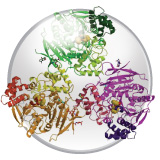
Enzymes are proteins present in living organisms which initiate, speed up or regulate biological processes. For example, it is the enzymes in our stomachs that break down food into a form that can be absorbed into our bodies and converted into energy.
Enzymes form a crucial pillar of industrial biotechnology and can be used in a wide range of industrial sectors for example in the production of biofuels, washing detergents, food and feed production and in the preparation of bio-based chemicals. The importance of enzymes in facilitating the development of the bio-based economy cannot be overstated.
In 2010, the global market for industrial enzymes was valued at $3.6 billion. Food and beverage enzymes comprise the largest segment of the industrial enzymes industry with revenues of nearly $1.2 billion in 2010, with the market for enzymes for technical applications alone making up $1.1 billion in 2010. Proteases currently constitute the largest market, although carbohydrases and lipases are the fastest growing segments. Estimates of future demand vary, with future markets of $6 billion- $8 billion expected between 2015 and 2016. The growth in demand for industrial enzymes will come from several sectors, including diagnostic applications, research and biotechnology, animal feed and food and beverage markets. The fastest regional growth will be in the smaller markets of Central and South America and the Africa and the Middle East.
Why are the advantages of enzymes?
Enzymes efficiently increase the rates of chemical and biochemical reactions which typically proceed very slowly, or in some cases, do not happen at all. Enzymes can work in mild conditions, for example low temperatures, and because they speed up reactions, using enzymes can improve the efficiency of processing raw materials, thereby saving time, water and energy. Enzymes are also environmentally benign and can often replace toxic chemicals. They therefore have considerable environmental and economic advantages over many other systems.
One everyday use proving the environmental and economic benefits which can accrue by enzymes is their use in washing powders. Enzymes have been used in detergents since the 1960s and since then they have helped reducing the amount of chemicals released into the aquatic environment and decreased the energy needed to do laundry. In fact detergent enzymes represent one of the largest and most successful applications of modern industrial biotechnology. Historically, the addition of enzymes helped reducing washing temperatures from 60°C+ to 40°C and with the new generation cold water enzymes, washing temperatures can even be reduced to 20°C, without sacrificing cleanliness. This substantial reduction in washing temperature saves 30% of the electricity used in laundry operations. Also, the duration of the washing cycle, water consumption and the use of harsh chemicals can all be reduced when enzymes are added to a detergent (as an example, addition of enzymes can reduce the use of surfactants by 50%). Since enzymes are bio-degradable, their use generally leads to a reduced environmental footprint.
What is the role of biotechnology?
Biotechnology has a crucial role in identifying enzymes with specific functionalities from natural sources and in providing routes to ensure that they are available at sufficiently high quantities for industrial production.
The newly developing area of synthetic biology means that novel enzymes can be engineered to have specific functions to respond to specific needs. Synthetic biology uses computer modelling to project how enzymes interact with substrates and can provide these enzymes with greater stability, selectivity, and activity than naturally-occurring enzymes. Enzymes developed through synthetic biology have the potential to catalyse reactions which can currently only be catalysed through chemical catalysis.
More information on
Enzyme on WikipediaEnzyme Biotechnology in Everyday Life